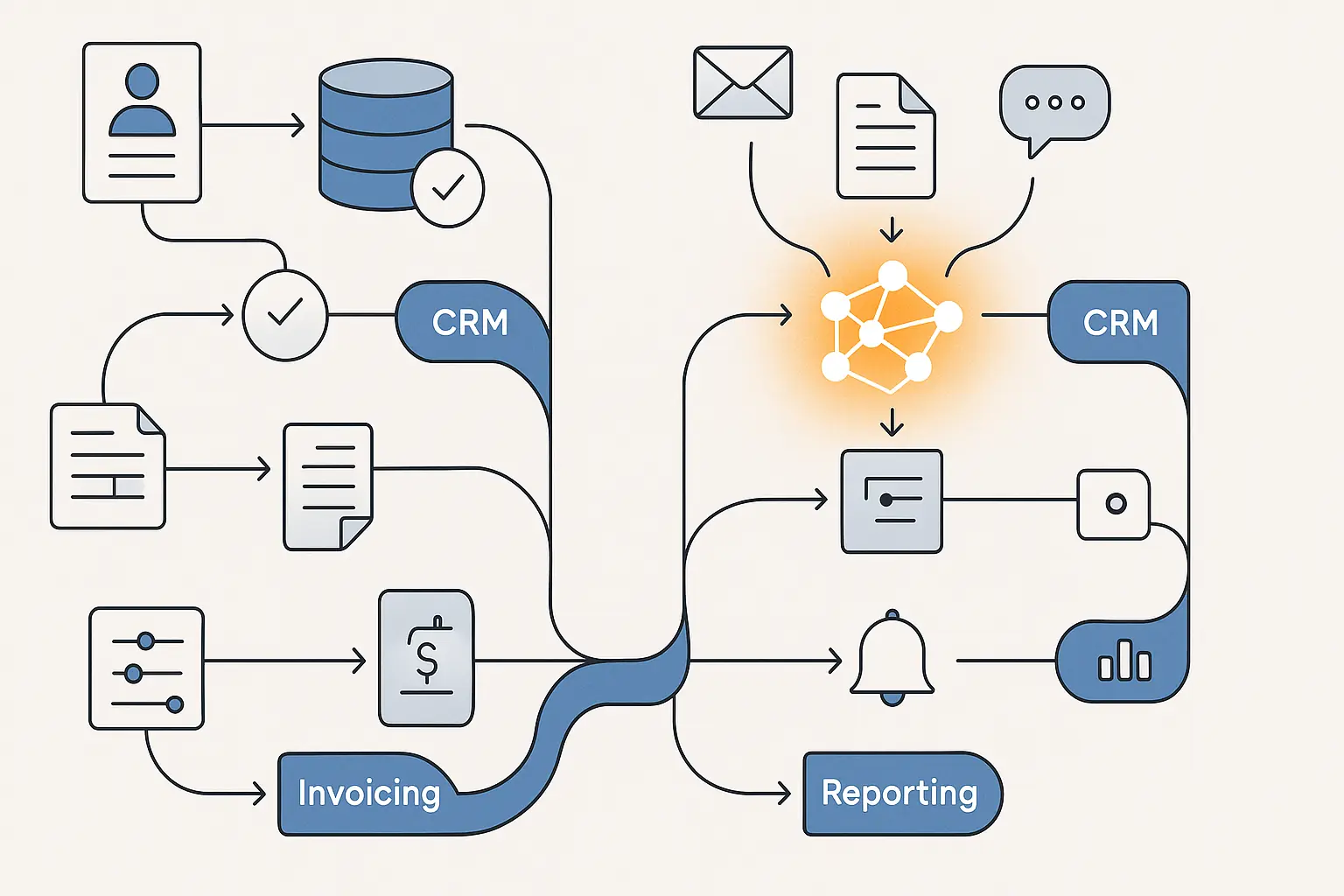
Business process automation services and AI workflow automation services solve different problems. Traditional business process automation services are best for stable, rules-based workflows that move structured data between people and systems, while AI workflow automation services add model-driven interpretation for unstructured, variable, or judgment-heavy tasks like email triage, document understanding, and knowledge retrieval. The right choice often depends on process variability, data quality, compliance requirements, and how much human review the workflow still needs.
If your process is predictable, traditional automation is often a simpler and lower-risk starting point. If the bottleneck is interpretation rather than handoffs, AI can help, especially when layered onto a clearly defined process rather than used as a substitute for process design.
What are business process automation services vs AI workflow automation services?
Business process automation services typically focus on designing and automating repeatable workflows across systems, teams, and approvals. In practice, that usually means rule-based logic, integrations, notifications, routing, status tracking, reporting, and standardized handoffs for processes like order processing, invoice approvals, CRM updates, onboarding, or service delivery.
AI workflow automation services use those same workflow foundations but add AI models where the process requires interpretation. That can include classifying inbound emails, extracting information from documents, summarizing tickets, drafting responses, retrieving answers from internal knowledge, or deciding how to route exceptions based on context rather than fixed rules.
Neither category is universally better. Traditional business process automation services are usually the better fit when the workflow is stable and the inputs are structured. AI workflow automation services make more sense when the process depends on reading, interpreting, or responding to messy, unstructured, or variable inputs.
What are business process automation services?
Business process automation services are implementation services that map a business workflow, remove manual steps where possible, connect systems, and automate repeatable actions using rules. The goal is to make a process faster, more consistent, and easier to measure.
How is AI workflow automation different from traditional process automation?
AI workflow automation differs from traditional process automation because it can handle ambiguity. Traditional automation follows predefined rules. AI automation helps when the workflow needs to interpret text, documents, conversations, or exceptions that do not fit clean if/then logic.
Where SMB buyers get confused: BPA, RPA, integrations, and AI automation are not the same thing
Automation terms are sometimes used interchangeably, even though they describe different layers of the stack. That confusion can lead to mismatched projects, unrealistic expectations, and selection of the wrong solution category.
BPA, or business process automation, is the broadest concept here. It focuses on improving and automating an end-to-end workflow. A BPA project might include process mapping, approvals, integrations, notifications, dashboards, and governance.
RPA, or robotic process automation, is narrower. It usually automates repetitive user-interface actions such as copying data between systems, clicking through screens, downloading files, or entering values into legacy software that lacks APIs. RPA can be useful, but it is often more brittle than API-based automation because it depends on the interface staying the same.
Integrations connect systems so data can move automatically between them. For example, syncing a form submission into a CRM, pushing order data into an ERP, or sending fulfillment updates into a support platform. Integrations are often part of BPA, but an integration alone is not the same as a full process automation project.
AI automation adds model-based interpretation or generation inside a workflow. It is useful when the system needs to read a PDF, classify an email, summarize a case, extract fields from a document, suggest a response, or route work based on context.
| Service type | What it is | Best-fit use cases | Data type handled | Implementation complexity | Risk level | Maintenance needs | Expected outcomes |
|---|---|---|---|---|---|---|---|
| Business process automation services | End-to-end workflow design and rule-based automation across people and systems | Approvals, routing, CRM/ERP sync, onboarding, invoicing, reporting | Mostly structured data | Often moderate | Often low to moderate | Commonly includes workflow updates, integration monitoring, and governance | Can include faster cycle times, fewer handoff errors, and better visibility |
| RPA | UI-level automation that mimics human actions in software | Legacy system entry, repetitive clicks, file downloads, copy/paste tasks | Structured data, screen-based tasks | Often moderate | Can rise if interfaces change often | Typically includes updating bots when screens or steps change | Can include reduced manual effort in repetitive desktop tasks |
| Integrations | System-to-system data movement via APIs or middleware | Lead sync, order sync, status updates, event triggers | Structured data | Often low to moderate | Often low | Commonly includes API versioning, field mapping, and error handling | Can include cleaner data flow, less duplicate entry, and fewer delays |
| AI workflow automation services | Workflow automation with AI for interpretation, generation, or probabilistic decisions | Email triage, document extraction, support summarization, lead qualification, knowledge retrieval | Structured and unstructured data | Often moderate to high | Can be moderate to high without controls | Commonly includes prompt tuning, confidence thresholds, monitoring, and human review | Can include faster handling of variable work and improved throughput on interpretation-heavy tasks |
| Hybrid approach | Rule-based automation for deterministic steps plus AI for exceptions or unstructured inputs | Invoice intake and approval, support triage, sales ops, claims or case handling | Mixed structured and unstructured data | Often higher than a single approach | Often moderate | Commonly requires both workflow governance and AI monitoring | Can include a balance of speed, control, and flexibility |
Examples that clarify the difference
- Invoice routing: BPA handles approval logic, routing, reminders, and ERP updates. AI helps if invoices arrive in different formats and fields must be extracted first.
- Lead qualification: Integrations can sync leads into the CRM. BPA can assign owners and trigger follow-up tasks. AI can score or categorize leads based on free-text inquiry details.
- Support triage: BPA can route tickets by form fields. AI can read the message, detect intent, summarize the issue, and send it to the right queue.
- Reporting: Integrations move data into a dashboard. BPA can schedule and distribute reports. AI can summarize trends or explain anomalies in plain language.
When traditional business process automation services are the better fit
Traditional business process automation services are usually the better fit when the workflow is already well understood and the main problem is manual coordination. If the process has clear rules, structured inputs, and repeatable handoffs, rule-based automation is often easier to test and govern, and may be easier to justify financially.
Choose BPA when the process is stable and structured
- Approval chains with clear business rules
- CRM, ERP, WMS, or accounting system syncs
- Form intake and routing
- Notifications, reminders, and SLA tracking
- Recurring reporting and dashboard distribution
- Employee or client onboarding workflows
- Order, fulfillment, or service handoff processes
These are environments where business process automation services often deliver clearer returns because the work is deterministic. You can define the trigger, the logic, the expected output, and the exception path up front.
Why BPA is often lower risk for SMBs
- Predictability: The workflow behaves the same way under the same conditions.
- Easier QA: Testing is straightforward because expected outcomes are known.
- Clearer compliance controls: Approval paths, audit logs, and permissions can be simpler to enforce in deterministic workflows.
- Cleaner measurement: You can track turnaround time, error rates, backlog, and completion rates more directly.
In logistics, e-commerce, and professional services, many operational bottlenecks are often caused by process and system issues rather than lack of AI. They are often linked to fragmented systems, inconsistent handoffs, and excessive manual follow-up.
What a provider should typically deliver
- Process mapping and current-state analysis
- Workflow redesign and future-state definition
- Integration setup between core systems
- Approval logic, routing rules, and exception handling
- Dashboarding, alerts, and reporting
- Governance, documentation, and team training
If your company is already investing in analytics and operational measurement, this stage can expose tracking gaps too. In those cases, clean reporting foundations can be as important as the automation itself.
When should an SMB choose BPA services instead of AI automation services?
An SMB should choose BPA services first when the process is rules-based, the data is structured, the workflow is compliance-sensitive, and the business needs predictable outcomes more than adaptive interpretation. BPA is often a strong first project because it can create the process clarity that later AI layers depend on.
When AI workflow automation services make more sense
AI workflow automation services make more sense when the process breaks down because humans need to read, interpret, summarize, classify, or draft something before the next step can happen. This often appears in inbox-driven workflows, document-heavy operations, support environments, and service teams dealing with exceptions.
Choose AI when interpretation is the bottleneck
- Unstructured document intake and field extraction
- Email triage and intent classification
- Knowledge retrieval across SOPs, policies, or service documentation
- Support assistance and case summarization
- Content drafting with human review
- Exception handling where the next step depends on context
- Lead qualification based on free-text submissions or conversation history
In these workflows, a fixed rules engine often becomes too brittle or too expensive to maintain because the inputs vary too much. AI can reduce manual review volume by handling the first-pass interpretation and passing low-confidence cases to a human.
The tradeoffs SMB buyers should understand
- Model variability: Outputs are probabilistic, not perfectly deterministic.
- Prompt and workflow design matter: Good results depend on careful implementation, not just model access.
- Monitoring is required: You need confidence thresholds, QA loops, and fallback paths.
- Hallucination risk is real: Generated outputs should not be trusted blindly in high-risk workflows.
- Human-in-the-loop controls are often necessary: Especially for customer-facing, financial, or compliance-sensitive actions.
That is why AI should usually sit on top of a defined process rather than replace process design. If the workflow has no clear owner, no exception path, and no measurement plan, adding AI usually increases complexity instead of reducing it.
How to choose the right engagement model for your SMB
The best buying decision usually comes from evaluating the workflow itself, not from starting with a preferred tool category. SMBs should compare service models based on the nature of the process, the data involved, the systems that must connect, and the operational risk of getting a step wrong.
Decision rules buyers can use
- Choose BPA for stable, rules-based, structured processes with clear handoffs.
- Choose AI workflow automation for unstructured inputs and interpretation-heavy steps.
- Choose hybrid when the workflow is mostly deterministic but includes variable intake, exceptions, or content handling.
Practical evaluation criteria
- Process complexity: Is the workflow linear or full of exceptions?
- Data structure: Are inputs clean fields or messy documents, emails, and conversations?
- System landscape: Do your core tools have APIs, or will legacy systems require workarounds?
- Compliance requirements: Does every action need an audit trail or approval checkpoint?
- Speed to value: Can deterministic steps be automated quickly before tackling harder interpretation tasks?
- Budget: Are you funding a targeted workflow fix or a broader operating model change?
- Maintenance burden: Who will own updates, monitoring, and exception handling after launch?
- Success metrics: What exactly should improve: cycle time, error rate, backlog, response time, or capacity?
Recommended phased approach
For most SMBs, the safest path is phased. Start by mapping the process and separating deterministic steps from interpretation-heavy steps. Automate the rules-based work first, then add AI where human reading or judgment is creating the bottleneck. This reduces project risk and makes it easier to measure what the AI layer is actually contributing.
Vendor questions to ask before starting
- What part of this workflow is truly rules-based?
- Where is AI actually being used, and why is it needed there?
- What happens when the model confidence is low?
- How is output quality monitored over time?
- What human review steps remain in place?
- How are exceptions logged, escalated, and resolved?
- What systems will be integrated, and how reliable are those connections?
- How will success be measured after launch?
- Who owns maintenance, retraining, prompt updates, and workflow changes?
Can a business use both traditional automation and AI workflow automation together?
Yes. In fact, many of the best implementations are hybrid. A business can use traditional automation for routing, approvals, integrations, and reporting, while using AI only for the steps that require reading, classification, summarization, or contextual decision support.
What outcomes should you expect, and what should you do next?
If you choose the right model, SMBs should expect practical operational gains: faster turnaround times, fewer manual handoffs, better visibility into workflow status, reduced avoidable errors, and more team capacity for higher-value work. The key is not whether a provider leads with BPA or AI. The key is whether they clarify process scope, exception paths, system dependencies, and measurement before they start selling tools.
A good provider should be able to tell you which parts of the workflow need deterministic automation, which parts may benefit from AI, and which parts should stay human-reviewed. That is the difference between a production-ready system and a demo.
If you are comparing service models now, use this shortlist before you commit:
- Process stability
- Data structure
- Compliance sensitivity
- Human review needs
- Integration requirements
- Measurement plan
When you are ready to explore the right fit, book a call. You can also review the homepage or reach out through the contact page.